Anyone who wants to improve board minutes usually looks at the template, the wording and how long it takes to send them out. A large part of their quality is decided earlier, in the meeting. A resolution that was never clearly stated in the room cannot be recorded cleanly afterwards. That holds for the minute-taker just as much as for an AI.
Chairing a board meeting means leading it so that, at the end, it is clear for every agenda item what was discussed and what was decided. In most Swiss companies this is the job of the chair of the board of directors. This article covers what the law requires, which habits have proven useful and how they show up in the minutes. (It does not replace legal advice.)
What the Swiss Code of Obligations says about chairing
The Swiss Code of Obligations deals with chairing a board meeting only in passing. The board has a chair (Art. 712 CO), and that person normally chairs its meetings. The details are usually set out in the organisational regulations, for example who convenes the meeting, who chairs in the chair's absence and when the board has a quorum.
Four provisions concern the chair directly:
- Resolutions are passed by a majority of the votes cast. In the event of a tie, the chair has the casting vote unless the articles of association provide otherwise (Art. 713 para. 1 CO).
- Minutes must be kept of the deliberations and resolutions and signed by the chair and the minute-taker (Art. 713 para. 3 CO). Whoever chairs the meeting therefore vouches for the minutes with their own signature.
- At meetings, all board members and the persons entrusted with management are obliged to provide information (Art. 715a para. 2 CO). The chair makes sure questions get asked and answered and do not get lost when time runs short.
- Since the revision of Swiss company law, in force since 1 January 2023, members of the board and of executive management must inform the board immediately and fully of any conflicts of interest affecting them, and the board takes the necessary measures (Art. 717a CO).
Also since 2023, Art. 713 para. 2 CO expressly allows the board to pass resolutions using electronic means, for example in a video call. A hybrid meeting needs the same clarity as a meeting around one table, it is just harder to achieve over video.
Opening the meeting: three statements for the minutes
At the start, the chair establishes the quorum, has the agenda approved and asks about conflicts of interest. These first minutes look like formalities, but the whole set of minutes rests on them. It has proven useful to state three things explicitly:
- who is present, who has sent apologies and who attends as a guest, and that the board has a quorum
- whether the agenda is approved as it stands or changes
- whether anyone has a conflict of interest on any agenda item
The third question is often skipped because it feels awkward. Asked at the start and of everyone in the same way, it is not. If the company is about to award a contract to a firm on whose board one of the members also sits, this is the moment to say so. If a member recuses themselves from an item, that belongs in the minutes under that item.
Introducing each item with its purpose
At the start of each agenda item, the chair says whether it is for information, for discussion or for a decision. For information you listen; for a decision you want to have read the papers. One sentence is enough, for example "Item 4, management asks for the marketing budget to be released, we decide today". After that, everyone knows where the discussion is heading.
This is easiest when it is already in the invitation. We described how to build an agenda with motions and papers in the article on board meeting preparation.
How do you word a resolution that is unambiguous in the minutes?
A resolution becomes unambiguous when the chair reads out the final wording of the motion before the vote and then explicitly asks for votes in favour, votes against and abstentions. It takes twenty seconds and saves a lot of rework.
In practice a motion often changes during the discussion. An amount is reduced, a condition is added, a deadline moves. The CHF 120,000 requested for the marketing budget might become CHF 80,000, with a report at the next meeting. If the only question afterwards is "Is everyone agreed?", it remains unclear to what exactly. The minute-taker then has to reconstruct what was decided and, when in doubt, check with the chair, often days later.
A clearly worded resolution answers four questions:
- What is decided?
- To what extent, with which amount or limit?
- Who implements it?
- By when?
"The board releases CHF 80,000 for the launch campaign in the fourth quarter. Management reports on its impact at the February meeting." That sentence can go into the minutes as it is, without interpretation. And if a resolution later has to be proven to a bank or the commercial register, it can be carried over unchanged into an extract of the minutes.
Stating action items at the end of each agenda item
The chair repeats any tasks that came up in the discussion before moving to the next item, with a name and a deadline. Many agenda items lead to such tasks even without a formal resolution. Someone provides figures, obtains a quote or clarifies a legal question. If they only come up in passing, they are easily lost.
A sentence like "Anna Meier sends the updated cash flow plan to everyone by 15 December" is enough. What matters is a real date, not "by the end of the month". What happens to these action items afterwards is described in the article on action items from board resolutions.
Time budgets, postponed items and hybrid meetings
A time budget per agenda item is less about cutting discussions short than about noticing in time that a topic needs more room. The chair can then decide deliberately whether to extend, postpone another item or give the topic a meeting of its own. Postponed topics should appear as postponed in the minutes so that they come back on the next agenda.
Hybrid meetings add something. Participants joining by video often cannot see which paper is on the table in the room. The chair can make up for this by naming the agenda item and the document explicitly, for example "we are on item 5, page 3 of the budget", and by actively inviting contributions from the video call.
Why good chairing makes better minutes
Minutes are made from what was said in the meeting and from the context, meaning the agenda, the papers and earlier resolutions. The clearer that context, the more precisely each section can be assigned. That applies to a minute-taker sorting their notes afterwards and to an AI drafting minutes from a transcript.
If a meeting is led item by item, the recording is already structured. If the motion was read out, the wording of the resolution is in the transcript. And if action items were stated with a name and a deadline, nobody has to guess them. An AI can summarise a great deal, but it cannot word a resolution that was never passed in the meeting.
The live view in HeyEla
The live view in HeyEla is built for this flow. During the recording it shows the current agenda item with its type, the motion, the presenters and the papers. The chair can share the view in the meeting room or in the video call, present documents directly and conclude an item before moving on to the next. Everyone sees where the meeting stands and how much time is planned for the current item.
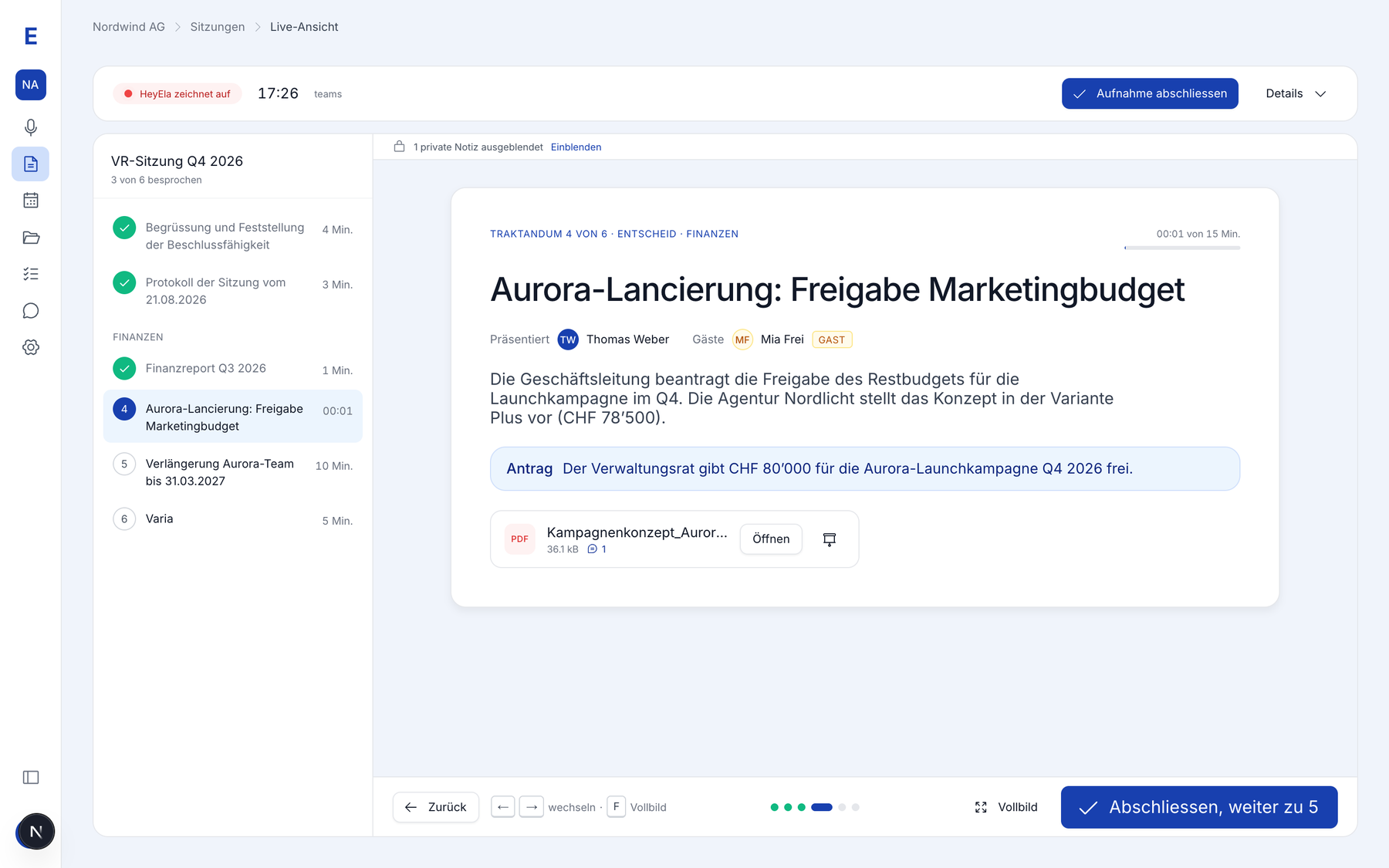
Along the way, HeyEla records from when to when each agenda item was discussed. Each section of the minutes can therefore be assigned to the right item, even when the discussion jumps back. The live view is part of live recording. The page on AI protocols shows how the draft minutes are produced afterwards.
Checklist for the chair
- establish attendance, quorum and the agenda at the start
- ask about conflicts of interest for all items at the start
- introduce each item with its purpose, whether information, discussion or decision
- read out the final motion before the vote
- explicitly ask for votes in favour, votes against and abstentions
- repeat action items with name and date at the end of each item
- name postponed topics as postponed
- in hybrid meetings, name the item and the document and involve participants on video
Conclusion
The law sets few requirements for chairing a board meeting. Art. 713 CO covers the casting vote and the signature, the organisational regulations cover almost everything else. How much rework the minutes need is still decided in the meeting.
Two habits cost nothing and work from the next meeting on. Read out the final motion before the vote. And state action items at the end of each agenda item, with a name and a date. What the law requires of the minutes themselves is covered in the article on Art. 713 CO.
Frequently asked questions
Who chairs the board meeting? Normally the chair of the board of directors. Who takes over in the chair's absence is usually set out in the organisational regulations or the articles of association, often the vice-chair.
Does the chair have the casting vote in a tie? Yes, under Art. 713 para. 1 CO, unless the articles of association provide otherwise.
When does the board have a quorum? The Swiss Code of Obligations does not set a minimum attendance. The quorum is normally defined in the organisational regulations or the articles of association. The chair establishes it at the start of the meeting, and this belongs in the minutes.
Can the board pass resolutions in a video call? Yes. Since 1 January 2023, Art. 713 para. 2 CO expressly allows resolutions using electronic means. Resolutions in writing also remain possible, unless a member requests an oral discussion. For the chair, little changes in a video call. The chair establishes the quorum and explicitly asks for the votes of the members joining remotely.
Does every contribution have to go into the minutes? No. Art. 713 para. 3 CO requires minutes of the deliberations and resolutions, not a verbatim record. The minutes contain the essential considerations, the motions and the resolutions. If a member wants a dissenting opinion recorded, it goes into the minutes, because it can matter for their personal liability.